Mooncakes
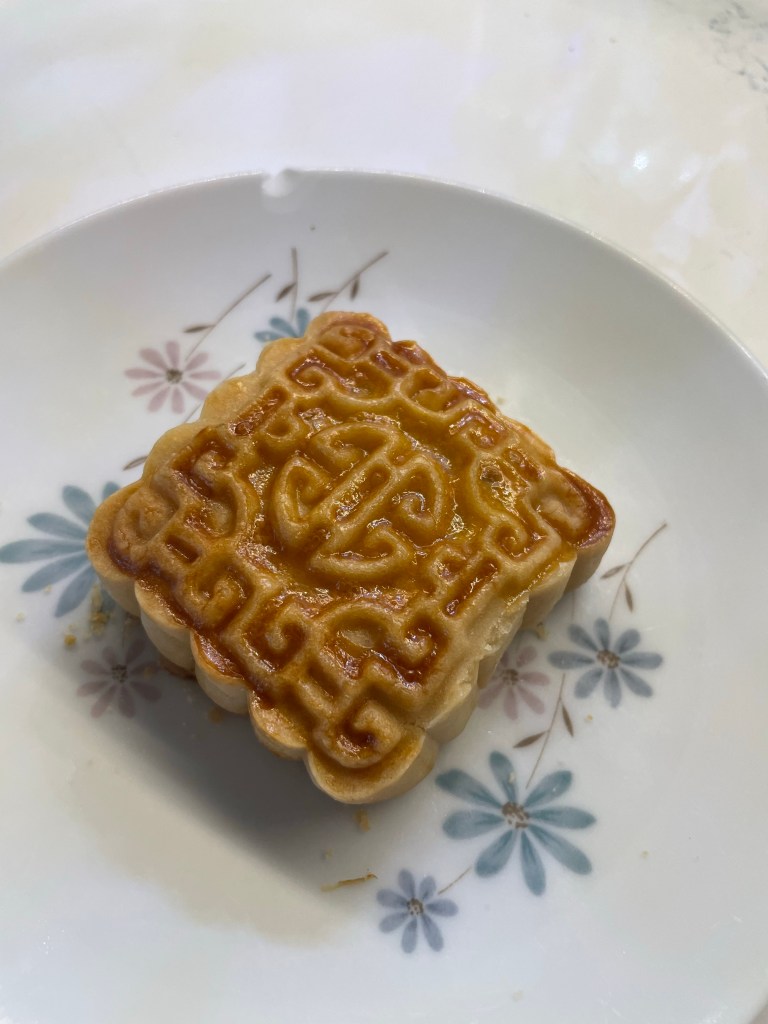
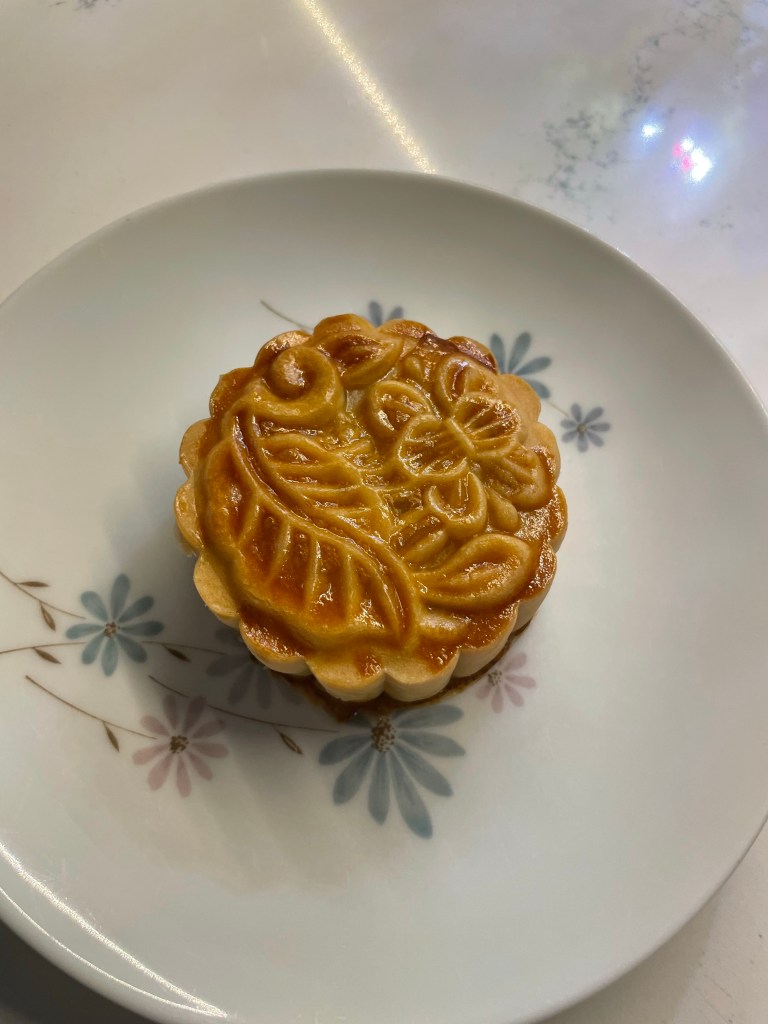
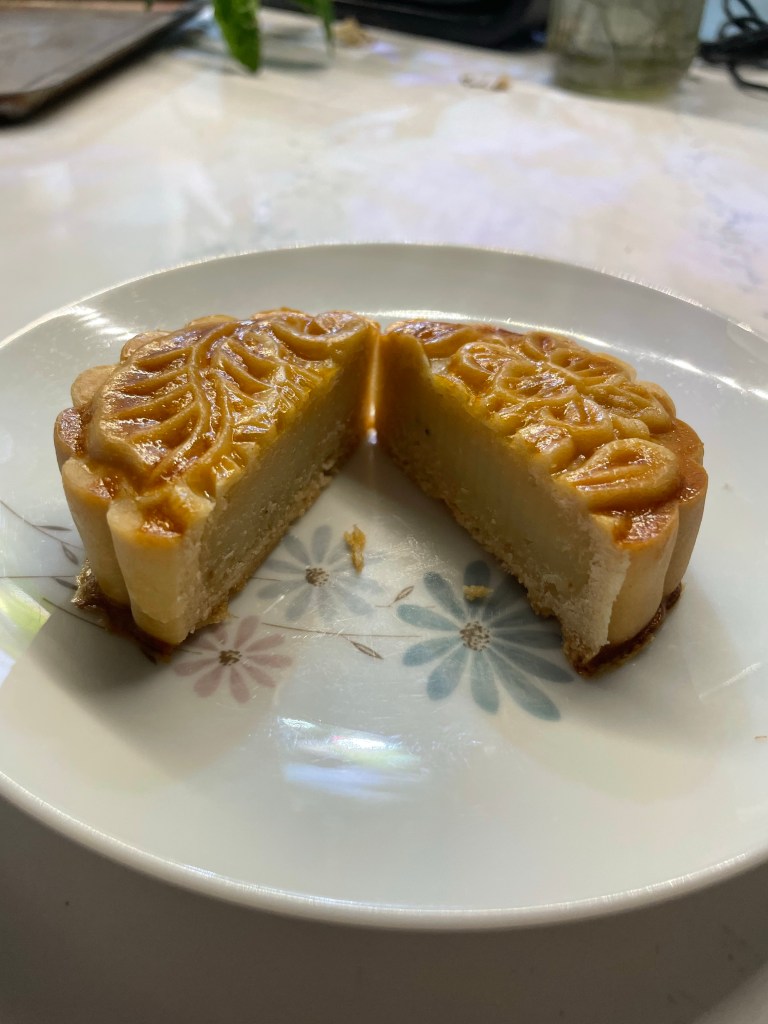
Recently I made mooncakes for a school project so I will inset my essay about mooncakes below if you’re interested at all!
In China mooncakes have been served for 3000 years, they symbolize family reunion and togetherness. The traditional Cantonese style mooncake has salted duck egg yolk in the center with a sweet lotus paste surrounding it, then a thin pastry covering the lotus paste and yolk. Mooncakes have been used as a sacrificial food during the Mid Autumn Moon Festival which supposedly became a custom during the Tang Dynasty (618-907 AD). Soon the custom of mooncakes being eaten during the Mid Autumn Moon Festival spread throughout the years in the late Yuan Dynasty (1271-1368) AD, to the Ming (1368-1644 AD) and Qing dynasties (1644-1911 AD). At first mooncakes were called Taishi cakes in the Shang and Zhou dynasties but later evolved into mooncakes. Taishi cakes were invented to commemorate Wenzhong who created the cake. Taishi cakes are ultimately the predecessor of mooncakes with almost identical similarities to mooncakes though are thinner with a thick middle. In history mooncakes were not just eaten but also used to send messages to get people together and revolt against brutal rulers. For example the late Yuan Dynasty (1271-1368) AD was overruled by the Ming Dynasty using mooncakes to send a message to revolt. Zhu Yuanzhang the founder of Ming prepared his people for an uprising but was not sure how to send the message across, so one of his subjects Liu Bowen thought of an idea to put notes that said “Uprising on the 15th night of 8th lunar month” in the mooncakes and then sending them to resistance forces. This plan worked and that was the end of the Yuan Dynasty. (“Mooncake History: 3,000 Year s’ Timeline, Starting from Taishi Cake”)
The words imprinted on mooncakes usually are Chinese blessing words like “harmony” and “longevity” to symbolize peace and a long life. Sometimes they’re stamped with the name of the bakery that produced the mooncake, or business names if they are being given as a corporate gift. Or some will have moon associated symbols like the Jade Rabbit with flower decorations. The roundness of mooncakes represents wholeness, perfection, and togetherness. They are ritually eaten together with family during the Mid Autumn Moon Festival. Traditionally families cut a mooncake up into eight pieces since they are so calorie dense and filling. (“What Is Mid-Autumn Moon Festival 2022? (Simply Explained)”)
The reason mooncakes are a custom during the Mid Autumn Festival is because of the legend of Hou Yi and Chang E. There are different versions of this story and it is told in many different ways. The legend starts with ten suns in the sky, they are scorching and destroying crops and also killing the civilians. Hou Yi is summoned by the Emperor of Heaven to shoot nine of the ten suns. Hou Yi is able to succeed and shoot down all nine suns, the weather recovers and lives are saved. Hou Yi is then gifted with an elixir of immortality. While he was on Earth he met Chang E. They fell in love and got married. Soon Hou Yi wants to spend his life with Chang E and goes to the Western Queen Mother for the elixir of immortality, she agrees to give him the elixir with enough to split for two people to share a serving. Hou Yi arrives home and tells his wife about the elixir and they decide to drink it together on the fifteenth day of the eighth lunar month when the moon gets round and bright. However a greedy man named Feng Meng had overheard their plans and wanted the elixir of immortality for himself, on the fifteenth day while Hou Yi was out hunting Feng Meng attempts to steal the elixir. Chang E realizes she won’t be able to defeat him and instead drinks the elixir so she will ascend to the heavens where Feng Meng can’t reach her. Hou Yi arrives back home and realizes his wife had drunk the elixir without him. Chang E decides to live on the moon since it’s nearest to the earth. Hou Yi looks up to the moon and puts the foods his wife loved in the garden as sacrifice. He continues to do this every year on the fifteenth day of the eighth lunar month, setting up a banquet in hopes they will be reunited. (Chinese Mid-Autumn Festival Origins, Story and Legend., n.d.)
Chang E also has a rabbit companion on the moon known as the Jade Rabbit, supposedly you can see the shadow of Chang E and the Jade Rabbit during the 8th lunar month on the moon. The story of the Jade Rabbit is that the Jade Emperor wanted help preparing the elixir of life for mortals, he was worried humans would be too greedy for such a significant role and instead thought animals would be much better. The Jade Emperor went down to earth and disguised himself as a beggar and searched for a noble animal. As a famished and frail man he called out for help and food, soon after three animals arrived: the monkey, the fox, and the rabbit. The animals were sympathetic towards the man and left to search for food to supply him with. The monkey gathered fruits from the trees, the fox caught fish in the river, and the rabbit was unable to find anything. He sees the man enjoying his fish and fruit over a fire and feels sad to have not provided him with anything. The rabbit realizes he can sacrifice himself as food so he jumps into the fire for the beggar. Although in that moment the beggar retransformed into the Jade Emperor and saved the rabbit from being burned. Now that he knew the animals were noble enough to take the role of making the elixirs, the emperor took the rabbit up to the moon where he made elixirs and stayed safe from humans who would try to steal. The rabbit soon became so talented in his craft of making elixir’s that the Jade Emperor gifted him with a beautiful, dazzling, bright white coat, and from then on his coat looked like pure jade therefore giving him the name jade rabbit. (“The Jade Rabbit, 玉兔 – Yùtù”) The Jade Rabbit is not just known for its beauty but also symbolizes selflessness, piety, and sacrifice. (“The Jade Rabbit: 5 Interesting Things You Should Know”)
Overall mooncakes are extremely interesting, they have 3,000 years of history behind them and even the cooking process itself is time consuming but worth the beautiful outcome. Once in time they were used for sending messages for rebellion, and now for bringing families together.
Works Cited
“Chinese Mid-Autumn Festival Origins, Story and Legend.” Chinaculturetour.com, 2019, http://www.chinaculturetour.com/culture/mid-autumn-festival.htm.
Hannah. “Mooncakes and Rabbits: Celebrating the Mid-Autumn Festival.” Hello Future, 21 Sept. 2021, mmhellofuture.wordpress.com/2021/09/21/mooncakes-and-rabbits-celebrating-the-mid-autumn-festival/.
“Moon Cake, What Is Mooncake, Symbolize, Type, Brand, How Much and How Long Can Keep.” China Educational Tours, http://www.chinaeducationaltours.com/guide/mid-autumn-festival-mooncake.htm.
“Mooncake: Origins, Traditions & Symbolism – the HK HUB.” Thehkhub.com, thehkhub.com/mooncake-101/.
soh. “The New Trend of Celebrating Mid- Autumn Festival.” Hommyliciouz, 2 Aug. 2021, http://www.hommylicious.com/post/the-new-trend-of-celebrating-mid-autumn-festival. Accessed 23 Jan. 2023.
“The Jade Rabbit: 5 Interesting Things You Should Know.” Www.chinahighlights.com, http://www.chinahighlights.com/festivals/mid-autumn-festival-jade-rabbit.htm#:~:text=When%20it%20comes%20to%20Mid. Accessed 23 Jan. 2023.
 The Last Crumb